Jesus Washed Away Our Sins PNG
A Designer’s First Look: Clean, Reverent, and Purpose-Built
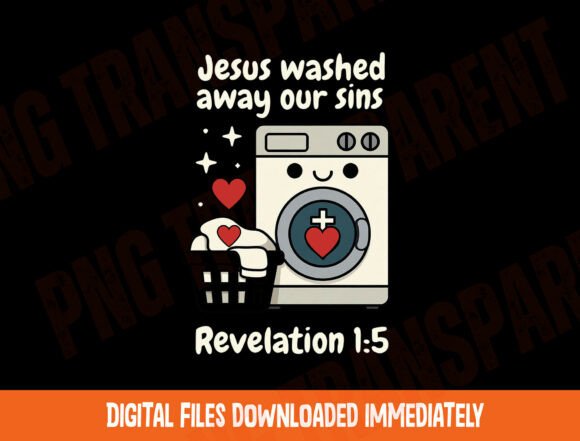
When I opened Jesus Washed Away Our Sins PNG, I didn’t see just another faith-based graphic—I saw a design with quiet intention. It’s not ornate or overly illustrated; instead, it leans into clean line work, balanced negative space, and a centered, readable phrase that carries weight without visual clutter. The typography feels hand-drawn but precise—slightly rounded, warm, and unhurried—like something you’d stitch onto a baby’s onesie or a linen tea towel for a church bazaar. It reads as sincere, not performative. That matters deeply when your finished product becomes someone’s daily reminder, gift, or keepsake.
This Design Lives Best on Soft, Thoughtful Products
I tested Jesus Washed Away Our Sins PNG in mockups across several real-world applications—and it consistently shined where emotional resonance meets gentle utility. On a natural cotton tote bag? Perfect. The phrase sits comfortably at 4.5 inches wide, leaving room for breath and fabric texture to show through. On a lightweight unisex sweatshirt? It holds up beautifully with medium-density fill stitches—no bleeding, no puffing, no need for heavy backing. For baby embroidery—think a gauzy swaddle or organic cotton bib—it translates well at reduced scale (3.25”) without losing legibility, especially if you simplify the outer outline to a single satin stitch border.
It also works thoughtfully on kitchen linens: a flour-dusted apron, a folded tea towel hung beside a farmhouse sink, even a small embroidered patch sewn onto a denim jacket sleeve. What makes it stand out isn’t flashiness—it’s appropriateness. This isn’t a design screaming for attention; it’s one that earns quiet respect over time. That’s why it fits so naturally in boutique branding, nursery decor, or holiday gifts like personalized Christmas stockings or Easter basket tags.
Where Caution Comes In: Real Fabric, Real Limits
Like any machine embroidery design, Jesus Washed Away Our Sins PNG needs thoughtful placement—not because it’s flawed, but because reverence demands care. On highly textured fabrics (like terry cloth towels or bouclé knit), the fine interior details—especially the subtle curve beneath “Sins”—can soften or blur unless you use a medium-cutaway stabilizer and reduce stitch density slightly. On thin or stretchy fabric (think tri-blend tees or ribbed baby bodysuits), skip dense fill areas entirely; opt for an outline + light satin stitch version instead. And avoid placing it directly over seams, darts, or curved surfaces like cap fronts unless you’ve pre-tested the distortion on scrap fabric first.
Dark fabric requires extra attention too. The design’s inherent contrast relies on clear letterforms and open spacing—not bold shadows or drop effects. So if you’re stitching it on navy fleece or charcoal denim, test thread colors carefully: a soft ecru or heather gray often reads more reverently than stark white. And never assume tiny serifs or connecting strokes will survive a 2.5-inch hoop without simplification. Zoom in before digitizing—those little curves matter for clarity.
What This Design Says About Your Craft—and Your Customers
Using Jesus Washed Away Our Sins PNG signals intentionality. It tells customers you choose meaning over mass appeal. When stitched cleanly on a handmade product—say, a linen pillow cover for a new mom or a custom-embroidered sweatshirt for a youth group retreat—it deepens perceived value. People don’t just buy the item; they buy the care behind selecting *this* phrase, *this* style, *this* level of craftsmanship.
For Etsy sellers and small shop owners, that trust compounds. A well-executed Jesus Washed Away Our Sins PNG on a curated product page—paired with a warm photo and honest description—builds brand consistency faster than trendy fonts ever could. It invites repeat buyers who recognize your thoughtful aesthetic, not just your pricing. And for commercial embroidery shops? It’s a reliable, low-risk addition to your T-Shirt Designs catalog—especially during Lent, Easter, or baptism season—because it appeals broadly without alienating.
Practical Designer Notes Before You Stitch
- Always test first—on the exact fabric and stabilizer you’ll use for the final piece. A $2 scrap saves hours of rework.
- Review stitch density before loading into your machine. If the file includes heavy fill under “Washed” or “Sins,” consider reducing density by 10–15% for lightweight fabrics.
- Confirm hoop size compatibility. If you’re working with smaller hoops (4x4”), plan for slight scaling or selective simplification—especially of connecting strokes.
- Check small details at 200% zoom: Are inner corners sharp? Do overlapping letters have enough clearance for clean satin stitch coverage?
- Test black-and-white mockups to gauge contrast on both light and dark backgrounds—this reveals hidden legibility issues early.
- Use proper stabilizer: Tear-away for stable wovens, cut-away for knits, and water-soluble film for delicate layers like lace overlays.
- Verify licensing before selling finished items or bundling the digital embroidery file. Not all T-Shirt Designs are cleared for commercial embroidery or resale as design assets.
Final Thought: It’s Not Just a Phrase—It’s a Promise in Thread
Jesus Washed Away Our Sins PNG doesn’t try to be everything. It’s not a flashy applique design, nor is it built for high-speed production runs on polyester performance wear. It’s quieter than that—and stronger for it. When stitched with care onto a handmade product, it becomes part of a story: the slow, steady work of faith made visible, one careful stitch at a time. Whether you're a craft business owner choosing designs for your next seasonal collection, an Etsy seller building meaningful inventory, or a hobbyist embroidering a gift for someone walking through grief or grace—this design earns its place. Just remember: its power lies not in how loud it shouts, but in how clearly it speaks—and how respectfully you let the fabric, thread, and intention hold space for it.