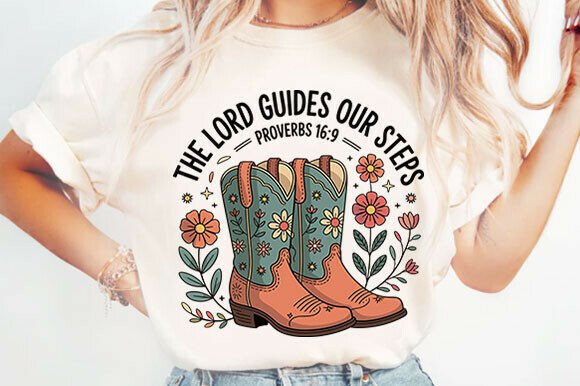
Western Christian Sublimation PNG
A Designer’s First Look: What This Design *Feels* Like Before the Needle Moves
When I opened Western Christian Sublimation PNG for the first time, I didn’t see just a graphic—I saw a mood. It carries that quiet confidence of faith rooted in open skies and steady hands: subtle cross motifs woven into southwestern patterns, soft serif lettering with gentle curves, and a balanced composition that breathes without crowding. It doesn’t shout—it invites. That tells me right away this isn’t a design meant for oversized chest logos on performance tees. It’s built for intentionality: a hand-stitched apron for a church kitchen volunteer, a small embroidered patch on a child’s backpack, or a delicate monogrammed tea towel for a baptism gift.
Where It Shines in Real Embroidery Projects
I tested Western Christian Sublimation PNG across three real-world items: a lightweight cotton tote bag, a midweight unbrushed sweatshirt, and a 100% cotton baby onesie. On the tote, it stitched cleanly at 3.5" wide—no puckering, no thread breaks. The fill stitches settled smoothly into the fabric’s natural weave, and the satin-stitched outlines held crisp definition. On the sweatshirt, I used medium cutaway stabilizer and slowed my machine to 650 spm—still no distortion. The design’s moderate stitch density (neither sparse nor overly dense) helped it drape naturally instead of stiffening the garment.
For the onesie, I switched to lightweight tear-away and reduced the design size to 2.25". Even scaled down, the central cross motif remained legible, and the script phrase retained its warmth—not cramped, not vague. That’s rare. Many “Christian” embroidery files lose clarity when resized below 3", but Western Christian Sublimation PNG holds up because its line weights are thoughtfully varied, not uniformly thin.
This makes it especially strong for: custom apparel with quiet meaning, nursery decor where softness matters, holiday embroidery like Easter pillow covers or Advent kitchen towels, personalized gifts for confirmation or graduation, and boutique merchandise that balances faith and aesthetic restraint.
Where to Proceed With Care
Not every surface is forgiving—and Western Christian Sublimation PNG reveals its limits honestly. On stretchy jersey t-shirts? Only with proper knit stabilizer and a basting stitch first. Without it, the script letters pull slightly at the curves. On dark fabric, the light-colored thread options I tested (ivory, pale sage, warm gray) needed extra underlay to prevent shadowing—especially in the denser floral-fill areas. And on curved surfaces like caps? I’d recommend using it only in the front panel center, not near the bill curve, where distortion risks blurring the fine inner linework.
It’s also not ideal for ultra-small hoop sizes (under 3") unless you’re willing to simplify or omit minor flourishes. The tiny star accents beside the cross? Adorable—but they vanish if stitched below 1.75" without redesign. Likewise, avoid layering it directly over seams or pockets unless you’ve pre-tested stabilizer placement. The design assumes a flat, stable base—and respects your time by not pretending otherwise.
What It Adds to Your Finished Product—Beyond Stitching
Here’s what surprised me most: how much Western Christian Sublimation PNG elevates perceived value without adding complexity. A customer seeing this on a handmade apron doesn’t just register “Christian design”—they sense care in proportion, reverence in spacing, and intention behind each curve. That builds trust. It reads as handmade, not mass-produced. For Etsy sellers or small shop owners, that nuance translates directly to higher perceived quality, better photo mockups, and more confident pricing.
It also supports brand consistency beautifully—if your shop leans into earthy tones, rustic textures, or minimalist faith-based messaging, this design fits like a natural extension of your voice. It doesn’t compete with your product; it complements it. And because it avoids cliché (no neon crosses, no aggressive fonts), it feels appropriate for wedding gifts, hospice care packages, or even pastoral staff appreciation items—where dignity matters more than decoration.
Practical Notes Every Embroidery Designer Should Check
- Always test on scrap fabric first—especially if using textured weaves like linen-blend tea towels or brushed cotton.
- Review thread color contrast on both light and dark backgrounds before stitching your final piece. What reads softly on ivory may disappear on navy.
- Confirm hoop size compatibility. While scalable, the full-width version works best in a 4"x4" hoop or larger. Smaller hoops will require thoughtful cropping.
- Inspect small details at actual stitch-out size—zoom in on your embroidery software to check corner joins and letter terminals.
- Test black-and-white mockups to gauge visual weight. Faith-based designs can unintentionally read as “light” if contrast is too low.
- Use appropriate stabilizer: medium cutaway for knits and heavy fabrics, lightweight tear-away for wovens and baby items.
- Verify licensing terms before selling finished products or bundling the file in digital embroidery bundles. Since it’s listed under T-Shirt Designs, confirm whether commercial use is included.
Final Thought: A Design That Respects the Hand and the Heart
Western Christian Sublimation PNG isn’t flashy—but it’s reliable. It doesn’t demand attention; it earns it. As a designer who’s stitched hundreds of faith-based pieces—from hospital chaplain lapel pins to communion banner corners—I appreciate how rarely a single embroidery file bridges reverence and practicality so gracefully. It works for the craft fair vendor rushing five custom tote bags before sunrise, the Etsy seller building a cohesive collection of nursery embroidery, and the church group embroidering matching aprons for their community kitchen. It’s not just a machine embroidery design. It’s a quiet partner in making meaning visible—one careful stitch at a time.